Verbatim reads the everyday writing students already do in Google Docs and surfaces, early and objectively, who might be at risk.
One in ten children is dyslexic, yet as many as 80% leave school without being formally identified. Not because the signs weren't there, but because no one had the time to catch them.
Around one in ten New Zealanders is dyslexic, one of the most common learning differences.
SPELD NZ, up to 10% of peopleMany go all the way through school without ever being formally identified as dyslexic.
APPG for Dyslexia (UK), 2019Often the only person tracking learning-support need, across hundreds of students at once.
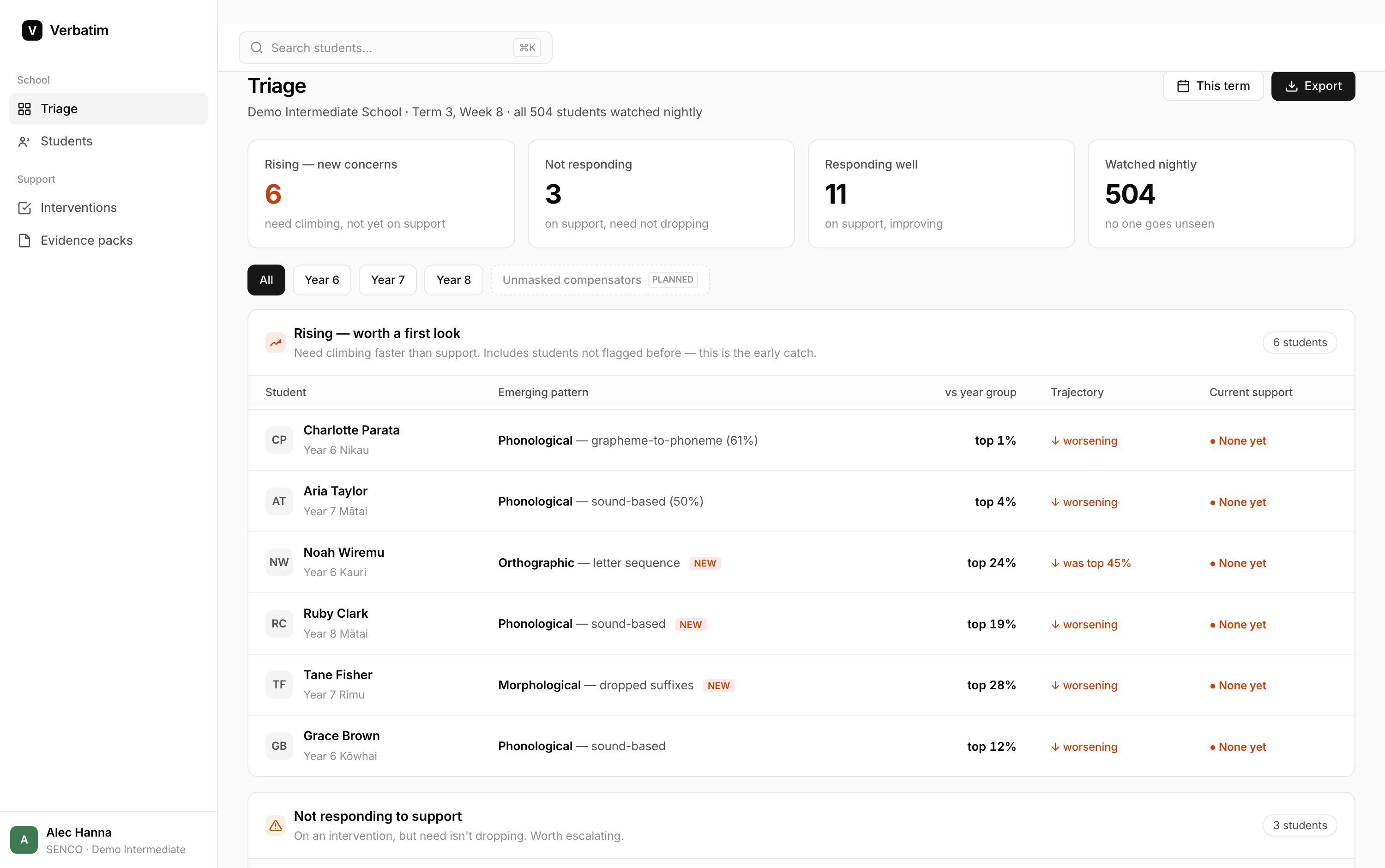
A structural reality in most NZ schoolsVerbatim gives a SENCO one place to see who's struggling, understand why, and show what support is working from the writing students already do.
A whole-school view of who might be struggling, ranked by who to look at first, so every student is on your radar, not just the ones who speak up.
Open any student's profile to see the shape of their writing over time: the kinds of errors they make, and whether things are getting better or worse.
Mark when support starts, and watch whether a student's writing actually responds. Evidence that an intervention is helping or that it isn't.
Turn weeks of everyday writing into an objective record to stand behind a referral, an assessment request, or a case for resourcing.
The kids who are quietly struggling get noticed early, so support can start before they lose ground or decide they're just bad at writing. The ones who mask it, or fly under the radar, stop slipping through.
Verbatim reads what one SENCO can't read alone. It points to who needs a closer look, and shows whether the support already in place is working, so limited time lands where it matters most.
Instead of hoping to spot it while marking a full class set, teachers get a quiet signal about which students might need a closer look, without changing how they teach.
Earlier support, and objective evidence to stand behind a referral or a case for resourcing. Families get a reason to act, instead of years of "wait and see."
The detection approach is built and runs today. It's grounded in published research, including Luz Rello's pioneering work in Spanish, and sharpened through conversations with New Zealand literacy and educational-assessment researchers who study how struggling readers actually get identified. It isn't validated on real dyslexic writing yet.
No English or New Zealand corpus of dyslexic students' writing exists to test against, so part of the work is helping create one. That means gathering real student writing responsibly, with consent and the right research and ethics oversight, then measuring how accurately Verbatim actually flags who's struggling. Building that evidence database is our main focus right now.
Verbatim won't call itself a screening tool until the evidence supports it, validated against real student writing and reviewed by researchers who do this properly. Until then it's an early signal to take a closer look, and a starting point for the people who can help.
Handling children's writing is a responsibility we take seriously. These are the principles the product is being built around, from the ground up.
Verbatim reads text to find patterns, then discards it. The design goal is to store the structured signal, the type and frequency of errors, and never the sentences a student wrote.
Student-level detail is for the school's own learning-support staff. The aim is that a school owns its data and decides how it's used, not us.
Any use of children's writing for research or product improvement will rest on clear, informed, opt-out-able consent, explained to families in plain English before anything begins.
Being straight about it: Verbatim is still in development, so these are commitments and design principles, not a description of a finished, audited system. Full privacy documentation will accompany any real pilot, developed with our partners and reviewed properly before a single student's writing is involved.
We're looking for a small number of New Zealand schools to help shape Verbatim and build the evidence base alongside us. This is a partnership, not a purchase.
A direct line to the founder. What your learning-support team actually needs drives what gets built.
Founding schools are part of the work that turns an honest prototype into a validated tool, done properly, with consent and research oversight.
Early access to the dashboard and the screening features as the research supports them.
Registering your interest costs nothing and commits you to nothing. It just starts the conversation.
Only a handful of founding-partner spots, and there's no cost, and no commitment, to putting your hand up.
Takes 2 minutes · No payment · No obligationThat's the part we help with. Take a look for yourself, or help us bring Verbatim to your school.